The Books of April
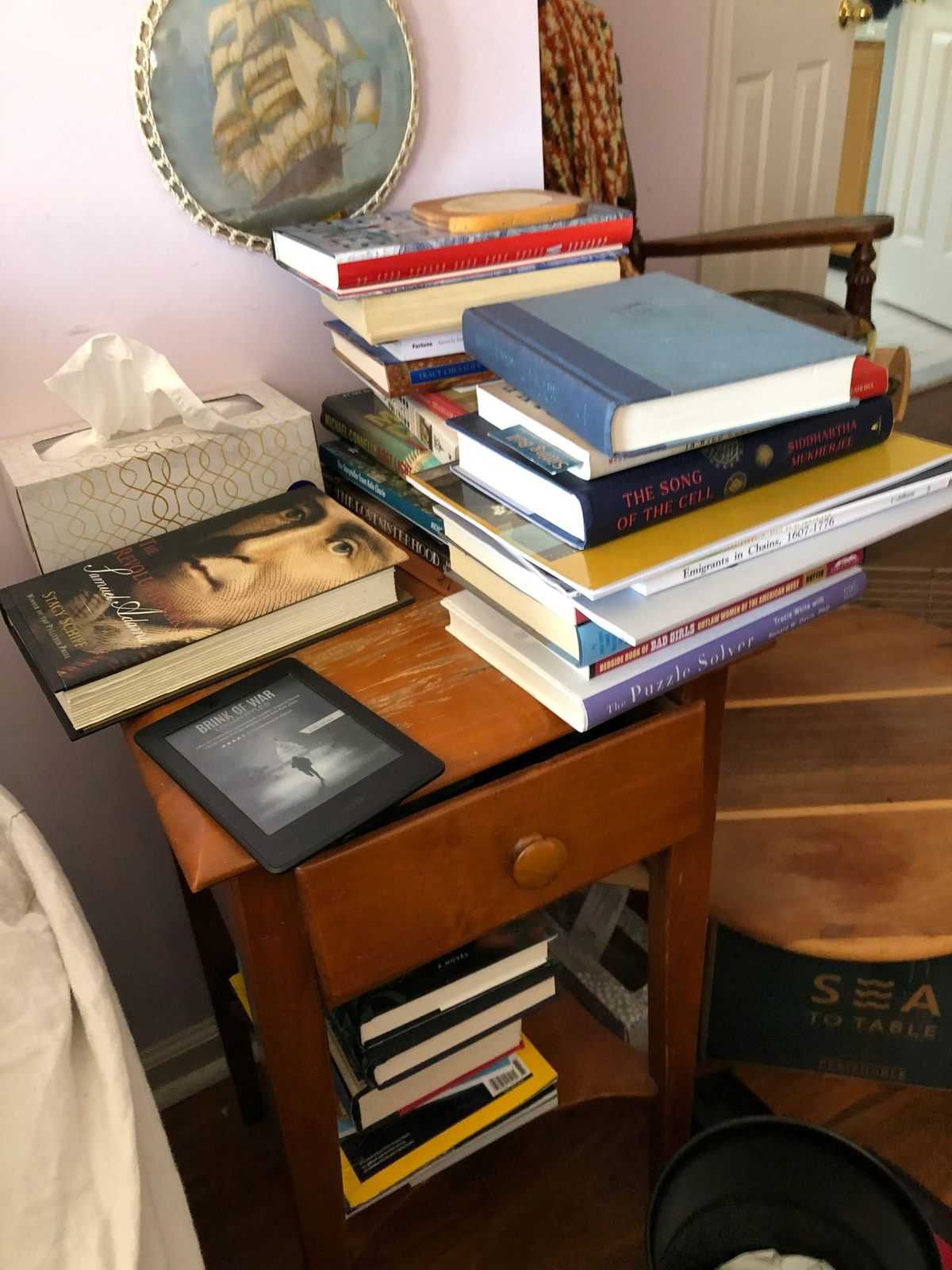
I neglected to write individual reviews for my blog of the books I read in April, so this round-up article will be more in-depth than usual.
Three Bags Full: A Sheep Detective Story — Leoni Swann, April 1–19, 2026
Look at the headline and you’ll see it took me a full 19 days to get through Leoni Swann’s debut sheep detective novel. It’s not that it wasn’t fun, just that it was slow at times.
Published in German in 2005 (originally misleadingly titled Glennkill: Ein Schafskrimi, or Glennkill: A Sheepcrime, even though no sheep commit a crime), Three Bags Full is told with a few exceptions from the point of view of a flock of sheep who find their shepherd, George, dead in their meadow one morning.
The sheep of the flock love George, who had a habit of reading to them every day. Sometimes he read a book on sheep diseases. Sometimes he read romance novels. Once he read them part of a murder mystery, but threw it away in apparent frustration before the end. This frustrates the flock as well and leaves them at a disadvantage as they set themselves the task of solving George’s murder.
Three Bags Full is one of a small number of books aimed at adults that are told from the animal’s point of view. The immediate comparison for many people will be Richard Adams’ Watership Down, the film version of which traumatized a generation back in the 1980s (“It’s a movie about bunny rabbits, how bad can it be?”). We’ll find out soon if the film version of Three Bags Full, starring Hugh Jackman, will also scar the psyches of youngsters soon, as it will be released May 8.
The best part of the book is the sheep: Miss Maple, the smartest sheep in the flock (and perhaps in the whole world), chief ram Sir Ridgefield, mysterious black sheep Othello, Mopple the Whale who loves to eat and remembers everything, Zora the ewe who loves clouds and abysses, and Melmoth, Sir Ridgefield’s long-lost twin.
A friend read the book at the same time I did and found it disappointing. She probably knows best, having read many, many more mystery novels than I have. Where a human detective may spend part of the story mystified about methods or circumstances, they at least understand human motivation. Sheep are continually unaware of much of the human world; they understand our words, but not what makes us tick.
What disappointed my friend the most, I think, was that Three Bags Fullviolated her expectations of a murder mystery. What delighted me, despite the sometimes glacial pace of the story, was the insight into how another species might look at us.
Five Little Pigs — Agatha Christie, April 13 -16, 2026
A few months ago, one of my sons suggested we watch Poirot, the Masterpiece series that ran from 1989 to 2013. It was a popular suggestion, and we’ve watched most of the series now. Over the course of its run, every one of Agatha Christie’s Poirot novels and short stories was adapted for television.
Hercule Poirot was one of Christie’s greatest characters: a short, plump, fastidious Belgian living in England, possessed of a great mind and a vast understanding of human nature, played in this series by David Suchet.
As much as I enjoy the series, only once so far has an episode grabbed me hard enough to go right out and read the story it was based on: Five Little Pigs, originally broadcast in December 2003, based on the novel published in 1942.
In this story, the murderer’s daughter asks Poirot to solve a murder that occurred sixteen years earlier, a murder for which a woman was convicted and sent to prison, where she died a year later. The murderer’s daughter believes her mother was innocent. Though skeptical he will find anything to contradict the official findings, Poirot accepts the challenge.
Poirot first interviews the people involved: the lawyers and the five survivors of the event. He asks these five, the five piggies of the nursery rhyme and title, to write him an account of what they remember of the events. All five agree to do so, launching the story into Poirot’s own version of Rashomon, eight years before Akira Kurosawa’s movie masterpiece.
Rashomon is the story of a crime as told through the eyes of several witnesses, including the victim via a medium, none of whom agree on details and all of whom try to make themselves look better than they are.
Christie’s wrote her story years before Kurosawa made his film, and even the story the movie was based on, written in 1915, wasn’t translated into English until the 1980s. It appears Agatha Christie anticipated Rashomon and the resulting Rashomon effect, without creating the same impact as the film.
One major difference is that while Kurosawa’s characters are trying to make themselves look good, Christie’s are convinced the woman did it and, except for one, have almost no reason to lie in their accounts of the events leading up to the crime.
The witnesses’ written accounts form the largest part of the novel, and they invite the reader to join Poirot in applying his “little gray cells,” his mind, to deduce the true murderer.
I was not disappointed in this novel, and enjoyed it just as much as the TV adaptation. As usual, it doesn’t bother me at all to read a mystery whose solution I already know; the journey is sometimes better than the destination.
Black River Orchard, Chuck Wendig, April 26 — April 30
I wanted to have more than two completed books in April, so I opened Black River Orchard on my Kobo e-reader without paying attention to how big it is: 640 pages in print. Yet I finished it in five days, which tells you how much the book grabbed me.
I’m not a horror fan. With one exception, Stephen King leaves me cold. Clive Barker is a no-go. There are other horror writers out there whose names elude me because I don’t read horror. But Chuck Wendig is an exception. I haven’t read nearly all of his stuff, but everything I’ve read I’ve enjoyed.
Over the past few years, Chuck seems to have been obsessed with apples. His blog has been full of his impressions of apples he’s found at local stands and grocery stores. And this book is either the reason for or the result of his exploration of heirloom apples, the varieties that weren’t developed in an ag school lab or sold in chain supermarkets, but come from small orchards, the kind you find at roadside stands or farmer’s markets.
The Ruby Slipper apple of this story, grown by failed farmer Dan Paxson, is one of these apples. It comes from an orchard of only seven trees. Its skin is a lustrous dark red, almost purple. The fruit is surpassingly, wondrously, magically delicious. To all who eat it, there’s no other apple like it, no other food like it. To others, it’s revolting, inedible.
The Ruby Slipper, as you might have guessed, is evil, and it intends to take over the world.
The primary reason I like reading Wendig is that his writing is so comfortable, even when his subject matter is horrific. His prose flows; his characters are real. I kept wanting the villains of this story to turn, to be what those who love them thought they were and expected them to be.
Like many of his other books, Black River Orchard centers on family, either traditional or found. The first few chapters reminded me of the opening of Wanderers, his 2019 novel, with its story of a family disrupted by forces beyond its control. Having to face forces that defy understanding is the basis of all horror stories, I think. Most of the time these forces can be overcome, though often at a significant cost. So they give us hope as well.