King Kongs
This article was originally published in Big List Energy on Medium.com
I watched all three King Kong movies over a recent weekend and started my Monday feeling a little nauseous. (No, not because of the movies. It was my GLP-1 pill. It’s that slightly nauseous feeling that keeps me from eating too much. Or nothing at all on occasion.)
So I decided to purge myself by ranking my weekend movie experiences. All I’m talking about are the three King Kong films, not Kong: Skull Island, not King Kong Vs. Godzilla, not the Rankin/Bass Saturday morning cartoon. Nothing derivative here, no franchises, no series. Just the same story, thrice told.
First, the worst
If the original Kong is a product of the 1930s, Dino De Laurentis’s 1976 production screams “I’m from the ‘70s!” and begs you to squeeze it in between The Poseidon Adventure and The Towering Inferno. There’s a visual slickness to it that pins it right in the disco decade.
The King Kong movies have always been about Beauty dooming the Beast. The tallest, darkest guy in Hollywood has always had a thing for blondes, and this film introduced Jessica Lange, who at the time was unknown but was certainly blonde.
Unfortunately, she played a painfully classic dumb blonde, far less self-aware than either of the other Beauties on this little list.
It’s telling that after this movie she took three years off, maybe practiced meditation and yoga and rethought her life choices, then returned as a genuine Triple Crown of Acting winner.
Not bad for a woman who started her career fighting a 40-foot ape to keep her clothes on.

Other missteps of this production include casting Charles Grodin as a hilariously cartoonish villain and replacing the Empire State Building with the World Trade Center, a decision that sparked a protest by Empire State Building employees.
If there’s any real improvement over the 1933 version, it’s the ape: the combination of a man in a monkey suit (yes, really) and a giant mechanical constructs made for a far more believable Kong.
The 1976 version was not a hit with the critics, but audiences showed up in droves anyway. Just like today, audiences in the 1970s loved spectacles (did I mention The Towering Inferno and The Poseidon Adventure?)
A satisfactory second
I watched the King Kong movies in order, so the 1933 original was first. I’d wanted to rewatch it for a while, and when I finished, I thought, hey, there are only two more, why not watch them all? It’s not like committing to watching all five versions of A Star Is Born, is it?
(No, I will not be watching and ranking all five versions of A Star Is Born, but I will say that as much as I like Barbra Streisand, it’s Lady Gaga who floats my boat.)
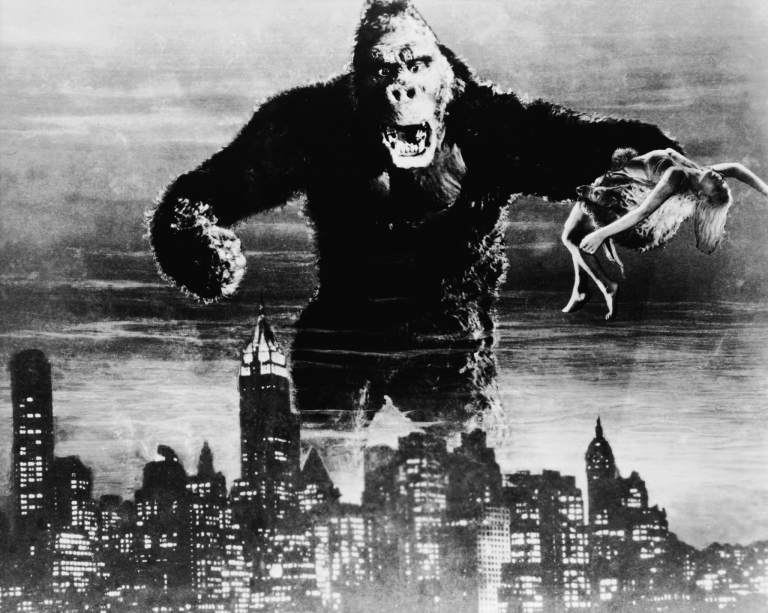
The original King Kong is a classic, of course, an original idea from the mind of director/writer/war hero/all-round badass Merian C. Cooper. Fay Wray was well-cast in the blonde-in-the-jungle role, and Robert Armstrong was slimily excellent as huckster movie producer Carl Denham.
Kong, however, had all the emotional appeal of a stop motion puppet with a goofy grin, a shortcoming Fay made up for by fighting with a giant ape finger to keep her clothes on and screaming a lot (a constant characteristic of all three films).

The only thing I didn’t like about this movie is that one scene where Kong kills the T. Rex. I’ve spent my whole life avoiding that, not just because of the visuals but for the horrifically vivid sound effects.
Third film’s the charm
The best came last: the crown jewel of the Kong movies, Peter Jackson’s 2005 remake.
Beauty in this incarnation is played by Naomi Watts, the beast by one of the masters of motion-capture acting, Andy Serkis. For the first time, we see a Kong who’s more than a big ape, playing opposite a woman who’s already shown she’s a survivor.

For me, the biggest difference between this and the earlier versions of the story is watching Watts’ character make decisions. She’s not drawn along by Carl Denham’s slimy charm like Fay Wray or rescued from a sinking yacht like Jessica Lange.
We see her think, then decide first to trust Denham, then to trust Kong, and finally decide to try to protect the creature that protected her.
Of course, in the end Kong dies because that’s always been the story: it’s Beauty that kills the Beast.
Is King Kong a metaphor, a message carrier for our times, or just a monster movie? Each version tells us something about the time in which it was made, the ways we exploit the world around us, and show women stepping up (or not) to take charge of their own lives.
It also shows that “the tallest, darkest leading man in Hollywood” can be something beyond a girl’s wildest dreams.