The Sixteenth Book of 2026: Inventing The Renaissance: The Myth of a Golden Age, by Ada Palmer
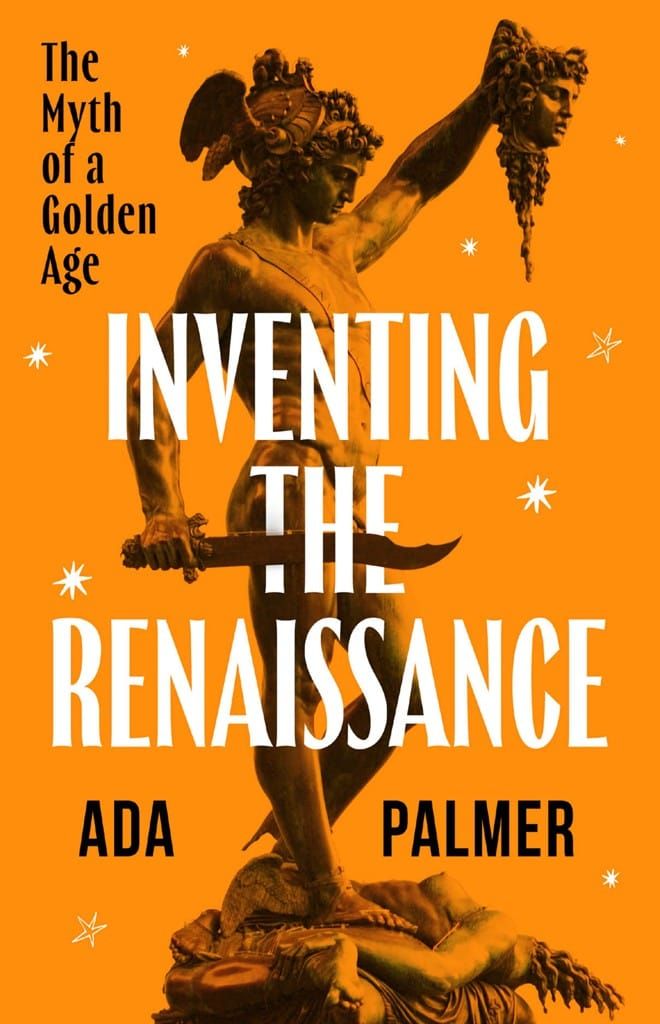
Read from March 25 to May 19, 2026
This book was part of my experiment in reading multiple books at a time. It’s a big book, and I needed a break from it at times. But I think its role in the experiment was a success.
Inventing The Renaissance isn’t a history book as much as it’s a historiography book, a book about how history is written. In the West, we often look at the Renaissance, that period of history that bridged the Middle Ages and the Enlightenment, as a golden age of art and politics, the age that brought us Michelangelo, Galileo, Luther, Columbus, Gutenberg, Machiavelli and so many others. An age where art flourished, where the church was perhaps starting to lose its stranglehold on culture, a time of discovery and advancement.
But by no means was it a golden age.
Palmer uses the book to show us that there are as many ways of showing us what the Renaissance was as there are historians to tell it. The facts are basically the same (though, as happens in history, the facts do occasionally change), but their interpretation changes from person to person and from time to time. Such is the way historians learn history and teach it to us.
Humans seem to need a golden age to look back on, and to aspire to. Palmer’s excursion through the people and events of the Italian Renaissance tell us that those who lived then looked just as hard back to antiquity, to the Roman and Greek classics, as we look back to them, and that they struggled just as much as we do with politics, war, money, leaders and personal triumphs and tragedies. Even as we think, in 2026, that we are losing so much, so they thought they were losing as well: stability, certainty, progress.
The Italian Renaissance, the centerpiece of Palmer’s book, wasn’t the only renaissance happening in the 14th, 15th, and 16th centuries. The English, French, Germans and Spanish were having their renaissances as well, largely because they all had access to the same set of cultural tools: the same set of manuscripts preserved from antiquity, the same overarching church, the same common language of Latin. In the West we tend to think of the Italian Renaissance as the Renaissance, and that’s where Palmer concentrates.
The book is, first of all, entertainingly written. It isn’t an academic tome; in fact, it’s downright snarky. It’s a popular history, full of personality and Palmer’s own labels for people and concepts. For instance, she presents various areas of academic study as “Labs”: the History Lab, the English Lit Lab, etc., and into each lab she tosses the individuals, the conferences, the departments, the publications that make up these labs. Then she places them each up and down a hallway from each other, and shows how by visiting these labs someone can dip into them and come up with insights and facts that broaden one’s view of one’s own work.
Similarly, people and places get their own labels. Rome isn’t the Eternal City, but the Eternal Problem City, because the main reason it’s important in this period of history is because it’s the seat of the Papacy, and the Papacy is the focus of so much of the political conflict from the families of the Italian city states like Florence (especially Florence) and Genoa.
Palmer shows us that the heart of the study of history (and of so much else in our world) is the asking of questions. In her own particular area of study, one of the big questions is “Was Nicolo Machiavelli (author of The Prince, the book that started the study of political science as we know it today) an atheist?” This question occupies much of the final quarter of the book, not so much because atheism is itself so important, but in how the question helps us view this transitional time in history. The answer, based on the evidence we have, is “we don’t know,” but it’s likely “yes and no.”
“Yes and no” is the answer that keeps coming up throughout the book, not only because so many questions don’t have a simple yes or no answer, but because the world has changed so much in 600 years. People couldn’t really talk about atheism in the 15th century the way we do now because they didn’t have the evidence or vocabulary to talk about it: the Renaissance started the process of breaking apart the church and developing the scientific method.
It’s not that Inventing The Renaissance advocates atheism; instead, it shows us the beginning of a world in which atheism as we know it today can exist.
The book ranges over far too much territory for me to cover here. I don’t take many notes when I read (something I probably need to work on), but if I had taken notes with this book, I’d need to write a book of my own to make use of them, not a few paragraphs of impressions. Palmer covers so much ground that she defies summarization, and I think I would be rewarded coming back to the book a second time.
But there was one sentence I highlighted that, I think, encapsulates her essential argument about how we should view and history:
“No one can ask big questions of a different world and come to our world’s answer.”
For better or worse, things have changed too much. Though our successes and failures, our struggles and triumphs, remain the same, the context in which they happen constantly changes, and that’s what history is here to show us.