The Nineteenth Book Of 2026: Without Me You're Nothing, by Frank Herbert with Max Barnard
Read June 23-29, 2026
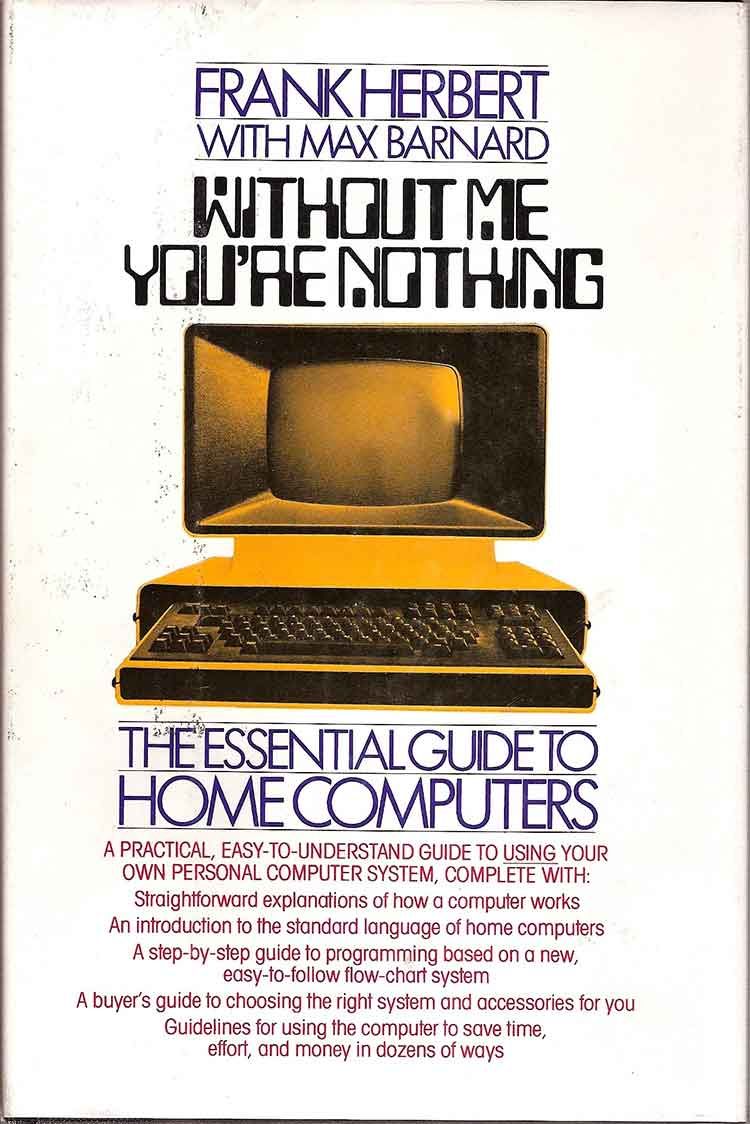
This is an old book, published in 1980, which I picked up for some historical research. It’s subtitled “The Essential Guide To Home Computers,” though it’s probably not what people expected when they read it.
The microcomputer revolution really got started in 1974 with the release of the Altair 8800 computer. By 1977, Radio Shack had released the first TRS-80, Apple had released the Apple II, and Commodore had put out the PET. By 1980, there were a lot of different small computers, and Microsoft was busy creating language software to run on them — BASIC, COBOL, and Fortran. The IBM PC was still a year away.
Without Me You’re Nothing wasn’t a computer buying guide. Herbert, best known as author of Dune and other science fiction novels, knew the world of computers was changing too fast to recommend specific products. Instead, the book was an attempt to guide the layman to learn about what computers could do. Like Ted Nelson’s 1974 two-sided book Computer Lib/Dream Machines, it was an attempt to demystify and humanize computers.
The thrust of the book is to help the reader understand that the computer is fundamentally a dumb machine. It works by switching circuits on and off — a fact that is repeated throughout the book. The only magic involved is that of speed. Unless you’ve printed this review onto paper, the devices you read it on — a laptop, a desktop, a phone, a tablet, an ereader — are merely different forms of the same machine, switching tiny circuits on and off.
Computers, Herbert tells us, don’t do anything on their own. This is the conceit that leads to the book’s title. When I first saw it, back when I was first playing with small computers, I thought it was the computer talking to me, telling me that I was nothing without it, a ridiculous assertion. But the title is actually us talking to the computer, reminding us that it is humans reminding the computer that everything it does, it does because a human or humans wrote a program to tell it what to do. There’s no such thing as a computer error, he tells us: errors result from software or data. At the lowest level, computers only do what people tell them to do.
Gradually, Herbert reveals the purpose of the book. Beyond educating a world on the verge of changes beyond its imagination, he is laying the groundwork of designing, or rather, imagining, the ideal writer’s computer. He never got what he called his "Rolls Royce" of computers, though he used computers enthusiastically.
Like Ted Nelson, Herbert’s book is full of admonitions to use computers and become computer literate, because if we don’t learn to use computers, they will be used against us. Though his view of the particulars was limited, his pleas for awareness were prophetic.
What kept me reading this was the difference between how we see and use computing devices now and how they were viewed nearly 50 years ago. Herbert sees things coming, some of which came true, some of which didn’t (or at least haven’t, on a mass scale). Herbert saw the world changing and wrote to warn and encourage us as we face the same changes.