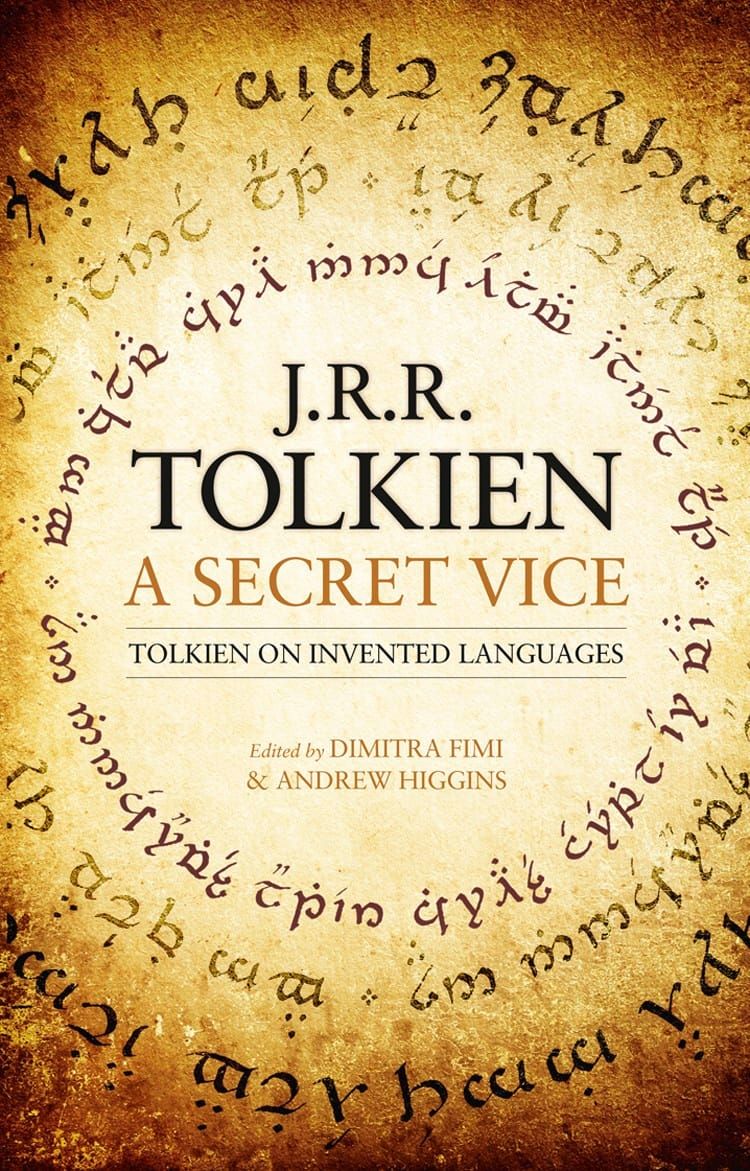
The Twenty Second Book of 2026: A Secret Vice, by J.R.R. Tolkien, Dimitra Fini and Andrew Higgins
Started 7/13/26, Finished 7/18/26
I have a lot of respect for Christopher Tolkien. The son of ridiculously famous author J.R.R. Tolkien, he spent most of his adult life going through his father’s works and trying to make sense of the embryonic notes and scribblings that ended up as The Hobbit, The Lord Of The Rings and so many other works both scholarly and fictional.
Many of these were essays or talks given before clubs and societies. Not only was JRRT a famous fantasy author, he was one of the world’s leading philologists, a student and teacher of the origin and evolution of language. Considering JRRT’s invention and use of languages in his fiction, one might say “oh, how interesting that he used his professional work in his writing,” but it’s actually the other way around: Tolkien was inventing languages long before he became a philologist. His hobby led to his profession, not vice versa.
So, how does this relate to Christopher’s lifelong work in editing his father’s papers? One of the texts he excavated and published was one of those talks, presented to a learned society in 1931, A Secret Vice, published by Christopher in the book The Monsters and the Critics and Other Essays. The book under review here is a critical edition of the essay, an exploration of the notes and revisions surrounding JRRT’s creation of the text.
So why is this important, or at least interesting, to someone who spends a lot of his reading time bouncing from science fiction to history to murder mystery to espionage and back? I’ve been reading Tolkien since I was 13, and one cannot read (and reread, and reread, ad infinitum) Tolkien without becoming intimately acquainted with his invented languages.
I’ll admit that most of my interest in JRRT focuses on The Lord Of The Rings (LOTR). I find The Hobbit a bit too much of a children’s book (though critical to knowing the whole story) and The Silmarillion a bit too dense. The decades-long work of Christopher Tolkien was too much bound up in the accretion of what has become known as the legendarium, the history and geography central to the stories. So I’d never heard of A Secret Vice until recently…and I could hardly wait for it to rise to the top of my vast To Be Read list. (I tried inventing a language once, during the pandemic, for a story that never came to be. Inventing languages could be an interesting hobby.)
JRRT started inventing languages when he was a child, and never really stopped. He had no practical reason to do so. He wasn’t trying to invent an auxiliary language like Esperanto (though he apparently knew and admired it). He was attracted to languages in general for what he perceived as their beauty, and his invented languages, particularly the Elvish tongues featured in LOTR, were developed with an eye toward their words and grammar being aesthetically pleasing. He believed words, and the way they are modified and fit together to create meaning, should give pleasure to the eye and to the tongue. Tolkien’s languages are art languages.
A Secret Vice is about JRRT’s secret vice of inventing languages. For him, the intellectual challenge and satisfaction of creating languages wasn’t enough. He believed that language was empty without a people to speak it, without lore and mythology behind it. So along with the creation of the Elvish languages, the Dwarvish language, and even Mordor’s Black Speech came the creation of those peoples and the world they lived in: Middle Earth, Numenor, the Undying Lands. Thus, A Secret Vice is as important a foundation to understanding JRRT’s creation as On Fairy-Stories, the 1939 lecture that laid out his views on fantasy as a literary form.
The authors of this critical edition of A Secret Vice see the essay as foundational to LOTR and the entire Tolkien legendarium, which they believe (correctly, I think) is itself foundational to much of modern fantasy and science fiction. Today many major modern works of speculative fiction come bundled with invented languages, thanks to LOTR having paved the way. The Klingon language rose from the original Star Trek series, which was broadcast right around the time LOTR was published in paperback in the US, and developed by Marc Okrand. David J. Peterson invented the Dothraki language for the TV series Game Of Thrones. Ursula K. LeGuin developed Kesh for her book Always Coming Home. Today there are hundreds or thousands of people inventing languages as a hobby, and books have been written to help them through the ins and outs of creating vocabulary and grammar.
At least in the early 1930s, with The Hobbit still five or more years down the road and LOTR hardly even imagined yet, JRRT felt a little shy about his eccentric hobby, though not so shy he was unwilling to talk about it. Like his letters and even On Fairy-Stories, the essay reveals more than a little about Tolkien the man: humorous, self-deprecating, not hesitant to go off on a lexicographical tangent to make a point, however obscure.
Being a critical edition, the hand of the editors (post-Christopher) is present. Dimitra Fimi and Andrew Higgins provide introductions and notes, giving the reader context for when the essay was written and even how it came to be, right down to the paper it was written on. They also provide handy links to books and websites for the reader to explore conlangs, or constructed languages, further.