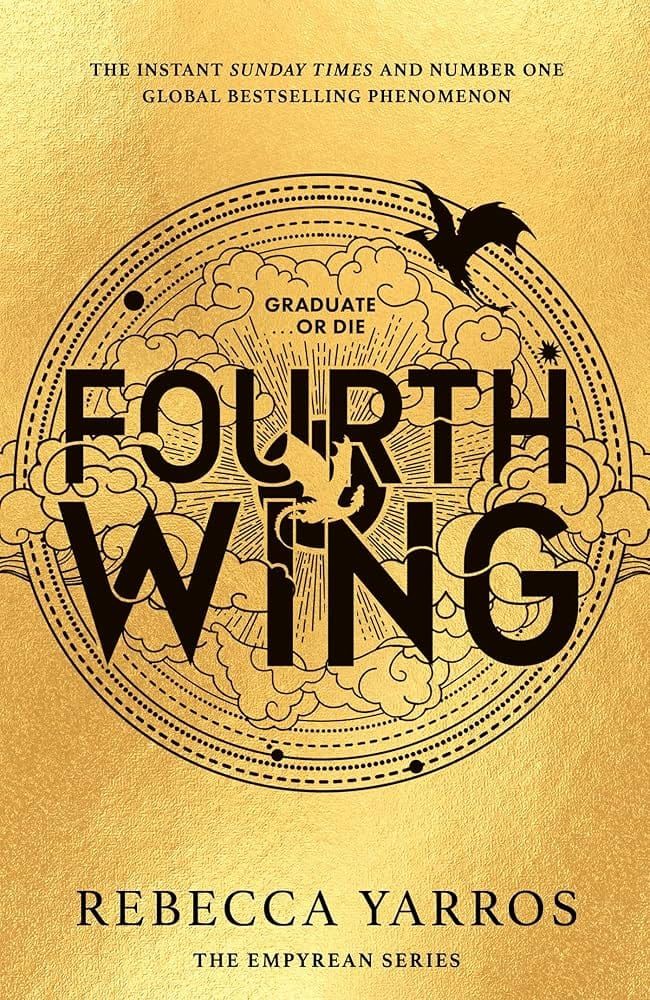
The Sixth Book of 2026: Fourth Wing, by Rebecca Yarros
Started sometime in the second week of February, 2026
Finished 2/22/26
The book blurbs have been silent this month because I failed to finish all but one of the books I’ve been reading. I decided to try a new reading strategy of pursuing multiple books instead of one after the other. Part of this was to see how well I’d do at it. Another part of this was because I was impatient and wanted to delve into certain books quicker. And the final part was my uncertainty about finishing some of the books I'd started this month. I try to follow Nancy Pearl’s Rule of 50:
If you’re 50 years old or younger, give every book about 50 pages before you decide to commit yourself to reading it, or give it up. If you’re over 50, which is when time gets shorter, subtract your age from 100 - the result is the number of pages you should read before deciding whether or not to quit. If you’re 100 or over you get to judge the book by its cover, despite the dangers in doing so.
I only need to give books 30 pages, so I need to look at the books I’m unsure of and either make my decision or read a little more.
However, sitting here close to the end of February, I am pleased to say I have finished one book: Fourth Wing, by Rebecca Yarros. For those familiar, this is a prime example of romantic fantasy or romantasy, a genre I’ve delved into only a few times. This one pulled me in when I read someone’s comments online saying the book and its sequels had absolutely captivated her. I thought, “It’s been a while since a book captivated me.” Like, not since that time I spent a Christmas vacation reading through most of Mick Herron’s “Slow Horses” espionage novels -- kind of the opposite of romantasy.
And while Fourth Wing didn’t totally wrap me up and keep me reading past my bedtime (whatever that is these days), I found Yarros kept me turning the pages. She started right off in protagonist Violet Sorrengail’s head, throwing up conflicts and motivations left and right, and didn’t let up until the twist on the final page. Oh, yes, I will be reading the sequels.
There were a few things I found off-putting. To start with, it was difficult for me to reconcile the language with the setting. I don’t have a problem with swearing or sexual euphemism, but they seemed odd in the quasi-medieval setting. It felt as if our characters had been transported from 21st-century America to a different planet, their linguistic baggage intact.Where they learned to bite off their words, however, so that every. Word. Became. Its. Own. Sentence. is a mystery. This very modern method of emphasis was overused. Like an exclamation point outside of dialog, a writer should limit this usage to perhaps once per book.
I also found the use of the “female gaze” a little hard to get used to, in part because I think male authors sometimes get a hard time for their objectification of female characters. And, perhaps, because I find the close description of female beauty more compelling than male beauty. But that’s just me, and I got used to it.
One thing I haven’t kept up on over the decades is dragon fantasy. I refuse to read George R. R. Martin’s Song Of Fire And Ice series because he’ll never finish it, so my experience with fantasy dragons begins with Smaug from The Hobbit and ends with Anne McCaffery’s Pern books. It’s been a few years since I read McCaffery, so I’m probably not remembering much, but it seemed the intimacy between rider and dragon was much deeper, and perhaps better done, than in Fourth Wing. But the death of a rider after the loss of his dragon was heart-wrenching nonetheless.
I’ll give Yarros a lot of points for excellent world-building, compelling (though sometimes close to clichéd) characters, and an overall readable writing style. I’m glad I have at least two, and possibly more, books to look forward to in this series.