The Twentieth Book of 2026: The Meaning Of Everything: The Story of the Oxford English Dictionary, by Simon Winchester
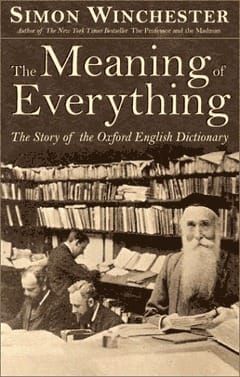
Read June 20 - July 1, 2026
I’d been looking forward to this, a history of the creation of the Oxford English Dictionary (affectionally known as the OED), and was a little disappointed because I thought there should be more to it, but in the end figured author Simon Winchester did just enough.
My initial interest came from not being able to get my head around how a dictionary is created. How does one actually come up with the words to put in it? We’re surrounded by the words of our language, and other languages, every moment of every day. How can we pluck a word from the sea of logos we swim in, define it, then snatch another, without missing all the other words? Winchester shows us it’s a long process, and not one that’s done alone.
The OED is different from your run-of-the mill Merriam-Webster. It’s a historical dictionary, not only giving definitions but also showing where words originate and how they are used over time. So not only did a few dozen people actually create the dictionary, but hundreds, or perhaps thousands, sent in slips of paper with examples of the uses of the words from their reading.
Naturally, this took a long time. Winchester details the origins of the dictionary at London’s Philological Society in the 1850s. The first bit of the dictionary was published in the 1880s. The first edition was completed in the 1920s.
Of there are people behind the dictionary’s story, and here is where Winchester spends the bulk of his time. Among the stories is one told in a separate book (and movie), Winchester’s The Professor And The Madman. But there are many accounts of success and failure and of the conflicts and personalities that nearly torpedoed the whole project, and eventually the realization that the dictionary was too important a work to be subject to petty things like profit and timeliness.
The dictionary is huge, of course. The original was ten large printed volumes. The second edition was twice that size. It’s unlikely the third edition, when it is complete, will ever be printed. There are over 600,000 words defined and given their historical context in millions of quotations from books, newspapers, diaries, and other sources, and the number is growing all the time.
In the 1970s, a compact edition of the OED was printed, two large books published side by side in a box. The print was reduced so four pages were printed on each page of the book, and a nice magnifying glass was included in a drawer at the top of the box. My grandparents had one. The compact edition was frequently offered at a discount to book clubs, who offered it as a membership. I still regret not taking advantage of one of those offers, years later. Now the dictionary is available online, available for a monthly subscription fee or as part of the online resources of many libraries.
The Meaning Of Everything was a surprisingly quick read: a book of relatively few words, about a book of impossibly many.