The Thirty-Third Book of 2026: Virtual Light, by William Gibson
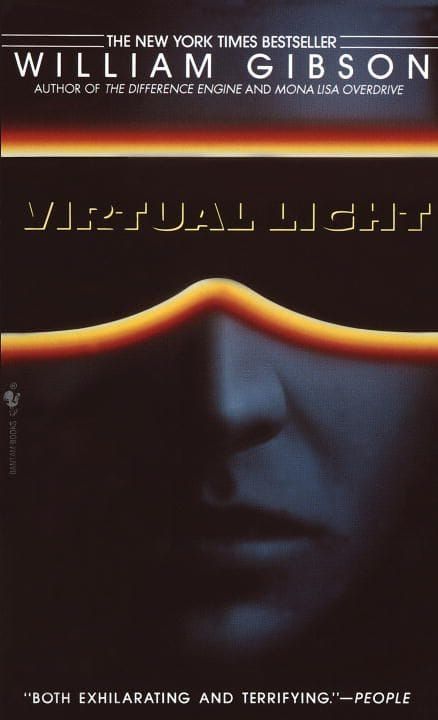
Started 9/30/26, finished 10/6/26
Published in 1993, Virtual Light is the first of William Gibson's Bridge trilogy. A step away from the futuristic cyberspace world of the Sprawl novels, Virtual Light takes place in a near-future California, now divided into two states, NoCal and SoCal. In NoCal, an earthquake known as the Little Grande has permanently closed the San Francisco-Oakland Bay Bridge. Now known simply as the Bridge, it has been colonized by an informal community of people who might otherwise be on the streets.
The story has two primary and one minor point of view character. Chevette Washington, a San Francisco bicycle messenger who lives on the Bridge, impulsively lifts what appears to be a set of fancy sunglasses from a man who harassed her after a delivery. When the theft is discovered, the man is murdered and a search for the glasses begins.
In Los Angeles, Berry Rydell, a former Kentucky cop now working private residential security, is fired after hackers lead him into a false hostage situation. Given the opportunity to travel to San Francisco to drive for another security contract, he travels north.
It turns out the security contractor Rydell is driving for is part of the effort to find Chevette and the glasses, which are actually a visual device that directly manipulate the optic nerve. They contain the secret plans to remake San Francisco using nanotechnology, much as Tokyo has been rebuilt after their own mega-quake, known as Godzilla.
Virtual Light isn't as innovative as the Sprawl novels. Gibson had decided to move on from imagining the far future to explore worlds a bit closer to home, looking at social trends and technologies that were coming to light in the 1990s. (Yes, there are cell phones in Virtual Light -- something Gibson has joked about missing in his earlier books).
The book has a fairly conventional "chase" plot (this isn't a complaint, I like chases and heists in books and movies), but has a lot to say about the relationship of haves and have-nots in urban America. The Bridge is almost entirely separate from San Francisco as far as residents and economy. It is anarchic and self-governing, with minimal connections to the cities on either end. The plan contained in the glasses would remake the whole city according to the desires of people and organizations with no concern for residents of the city or the bridge.
The third, relatively minor point of view character in the story is a Japanese sociology graduate student, Yamazaki, who is studying the Bridge community. Yamazaki provides some valuable continuity to the plot, but also helps Gibson comment on the Bridge community and provide some exposition about the world the story occupies.
Rydell and Chevette continue a thread Gibson started in Mona Lisa Overdrive of creating characters with severely limited views of the world around them. Neither is well-educated, and they both are working class, doing what they need to get by. They share a lack of impulse control which leads them into the problems they face in the story, which shows them learning to deal with the consequences of their impulsiveness. It also shows them learning to use that impulsiveness to survive and, equally, learning to make plans and marshal resources to carry them out.
In Virtual Light Gibson turns his fiction more toward reflecting the time he's writing. The Bridge trilogy seems very much a thing of the 1990s, even as the early 21st century will be reflected in the next set of three. But we still have two Bridge trilogy books to get through, so let's just get those out of the way first.