The Thirtieth Book of 2026: Count Zero, by William Gibson
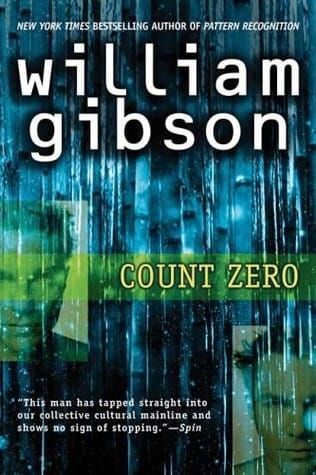
Started 9/21/26, finished 9/24/26
While William Gibson’s first novel, Neuromancer, defined a new genre of science fiction, his second book, Count Zero, solidified his standing as an author. The story is more sure, more complex, and overall better.
Neuromancer was so world-changing for me that I’ve long resisted the idea that Count Zero is actually a superior book, but my most recent re-read confirms it. Published in 1986, two years after its predecessor, it shows Gibson’s substantial growth as a writer.
Set seven years after the events of the earlier story, it shows how the world has changed after the merging of the two Tessier-Ashpool artificial intelligences, Neuromancer and Wintermute. Cyberspace is inhabited by mysterious entities that, in this novel, manifest as Vodou gods that use humans connected to cyberspace as their messengers.
Count Zero follows three different storylines, all of which come together at the end of the novel. First is a mercenary named Turner, employed to help a brilliant scientist defect from one zaibatsu, or mega-corporation, to another. Instead, the scientist sends out his daughter, Angie, and Turner’s team is wiped out. Angie’s father dies as well, and Turner and Angie run from the ruins of the operation.
The second story tells of Bobby Newmark, holder of the titular handle “Count Zero,” a young console cowboy wannabe in possession of an ICE-breaker (used to penetrate online systems) that nearly kills him when he uses it. He’s rescued by someone on the matrix he sense as a girlvoice, and he ends up in the hands of a group of apparent with the vodou cultists.
The final story is that of Marly Kruschova, a disgraced Parisian gallery-owner who is employed by fabulously wealthy businessman Josef Virek to discover the source of shadow box sculptures reminiscent of the work of 20th-century artist Joseph Cornell. These artifacts are mysteriously appearing on the market, and Virek wants to find the artist who creates them.
The weaving together of these three stories is a delight to read. There are echos of Neuromancer here, but the connections are mostly obscure. It's a substantial advance over the first book, still very much the work of Gibson early in his career. There are definite signs of the Gibson to come, though: not only the spare, evocative style, influenced by his great admiration of Beat author William S. Burroughs, but the early stages of his near-fetishistic attention to the detail of objects that appear in his stories, a characteristic that will only grow in the books to come.
AI Free: If I didn’t write this, why should I assume you want to read it? This post was entirely written by a human. No content was generated by AI, though grammar and spell checking may have been assisted by AI tools.